When growing up, I was always told by both teachers and professors that Wikipedia is an unreliable source due to its community driven editing platform. While it is true that anyone can make an edit to a page, I’ve noticed after extensive research that volunteers on the site consistently check for accuracy and make updates accordingly. As such, Wikipedia has become a fantastic platform to gain other references that are used within it’s articles in recent years and I personally consider the source to be fantastic
While I understood what my teachers of the past were trying to convince us (classmates) of , I can understand why they had this perspective on Wikipedia in the early 2000’s. I remember from personal experience that some pages would take a significant amount of time to be corrected if an individual edited a page in bad faith or unknowingly stated false information without a source. However, this has changed significantly over the last decade, and I myself have noticed that Wikipedia articles tend to be now more accurate than traditional sources due to their extensive volunteer community and constantly update-based infrastructure.
So for this blog, I wanted to verify my opinion again, and as such I conducted a good-faith editing experiment on a Wikipedia article to be able to experience the community and comprehend more about the process of how to properly edit an article. To begin this experiment, I had a bit of a rough start. I read the most popular articles with long edit histories but, honestly did not know enough about the topics to suggest making a credible source-backed edit. I read about topics such as Space, Planets, Politics, People, Art, History, but it was all incredibly difficult for me to suggest something new to add to the articles, because to be completely honest, they were very accurate. The search continued for quite some time and I had changed my priorities to not be solely focused on common or well known topics but, more obscure, not as much inquired information. I started branching out and looking up not as well known individuals and even small islands located in the Pacific to see if there were any tidbits of information I could add from credible sources that were not already present on the article. I’ve always had a personal interest exploring Google Earth to find desolate, but beautiful places and used that as my new starting point for finding a short article to add more information to.
Eventually, I stumbled upon what I was looking for. I kept using google maps and explored Islands namely in-between Africa and South America. I started there because during my childhood I had a small world map in my room and always wondered what happened on the small islands that were in incredibly difficult to reach places such as Ascension Island or even St. Helena. Funnily enough, that’s how I learned where Napoleon Bonaparte was exiled to after his second failed conquest in Europe. Eventually, I found a small Island in the South Atlantic Ocean named unironically, Inaccessible Island. I looked up YouTube Videos about the Island and pulled up the Wikipedia article to determine if there is A) Any Missing Important Information and B) History about the island that is not mentioned and backed with credible sources. After reading through thoroughly, I went down a rabbit hole about how the Island was native to the smallest, flightless, bird called the Inaccessible Island Rail. This was extremely intriguing to me as the question “How would a flightless bird be native to an Island?” popped up in my head. Quickly, I went to the talk tab after credible source research, made a comment, then the edited the page hours afterwards. Considering that the Talk tab hadn’t had any activity for 6 years, I was not certain I would get any responses.
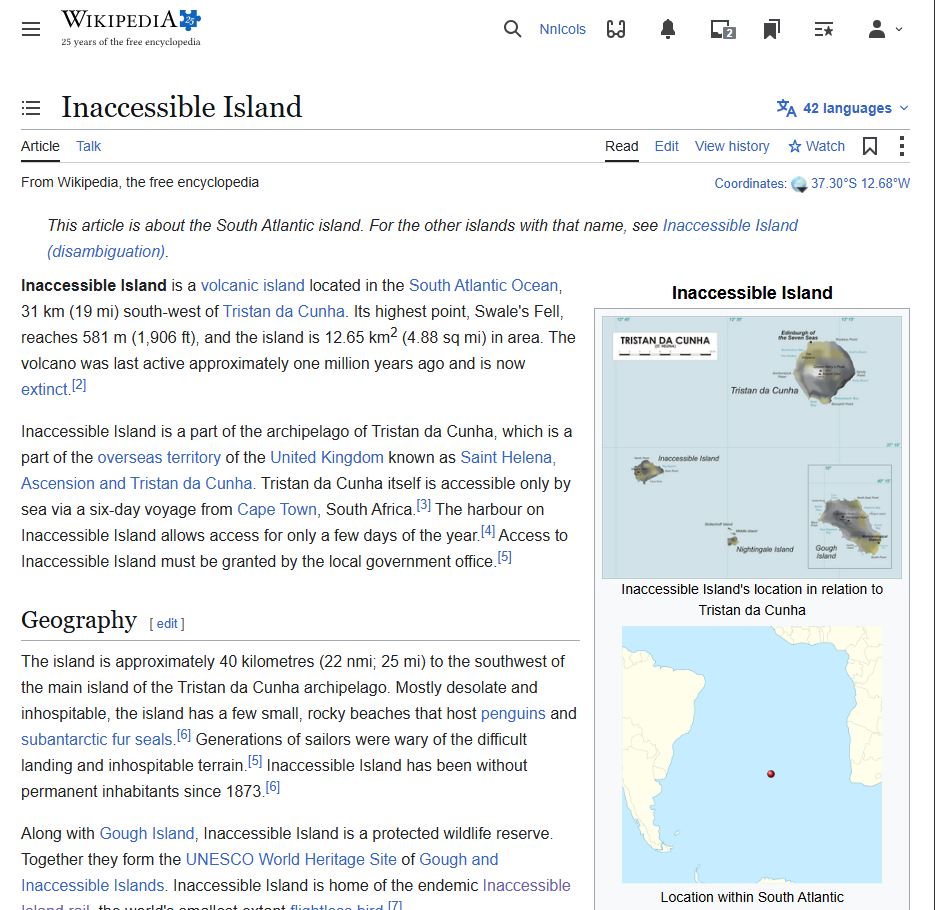
Below is the Article on the Island
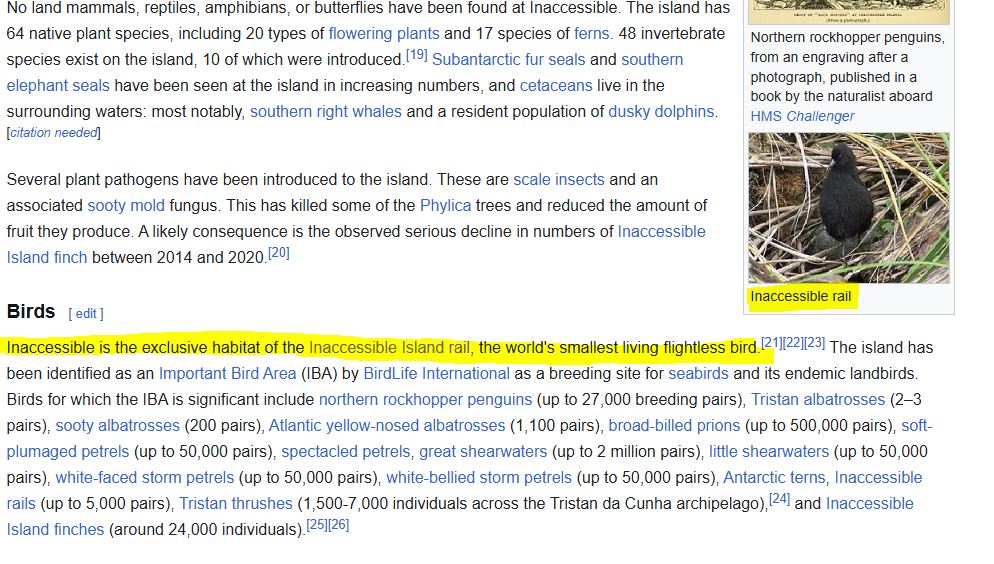
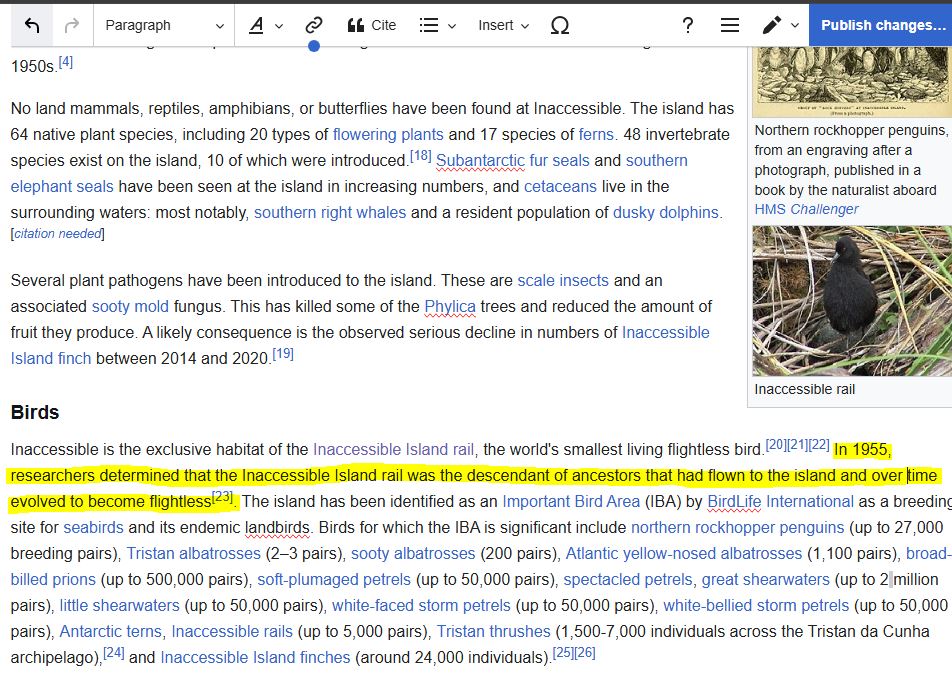
Here’s the part of the article I wanted to edit which is highlighted below.
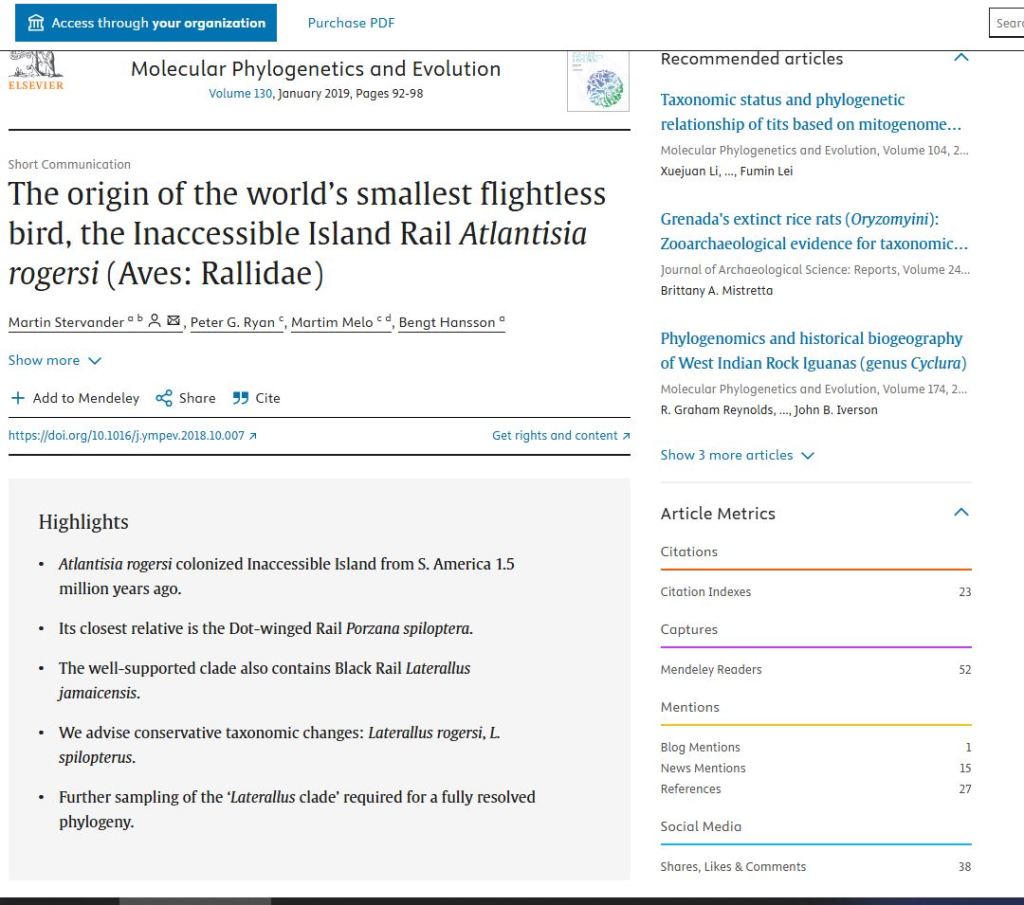
Here is the credible source online I wanted to cite as evidence discussing how researchers determined in 1955 that the Inaccessible Island Rail evolved from birds, that did indeed fly.
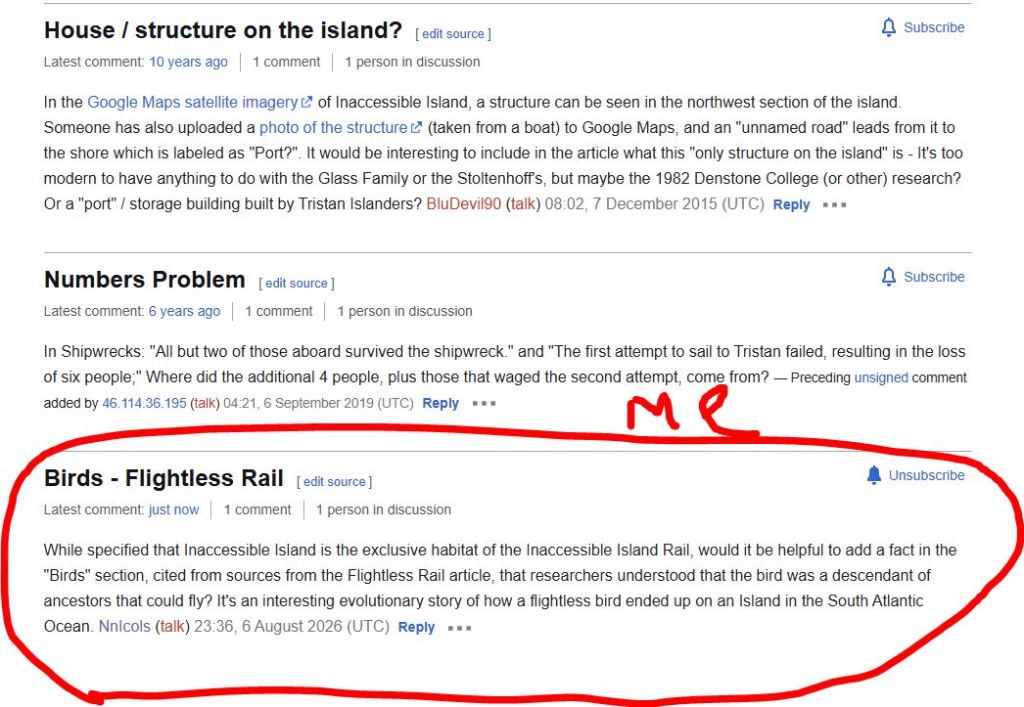
Then asked in the Talk section of Wikipedia if I can make the edit
Afterwards I waited for a while and then made the edit.
So what did I think of this experience and how did it change my outlook of Wikipedia? Honestly, this experience actually reinforced my opinion of Wikipedia, especially during the “search” part to find an article that was inaccurate or not the entire picture. It took me hours to find a page that was unfinished, and not necessarily incorrect. Therefore, my opinion of Wikipedia is even better than before. I think that the volunteers of Wikipedia really need to be more appreciated by society as they put in hard work and effort to be an accurate encyclopedia. While small and obscure pages, like the one I edited are not as up-to-date so to speak, the big picture articles are incredibly accurate. My final understanding of Wikipedia is that it is a great source to gain an idea, but when you go to more obscure pages about topics or places that are obscure, the accuracy becomes fuzzy and important details can be left out. Nonetheless, I find this to be also true of the internet in general. Finding a credible source to make my edit was actually quite difficult as there were little academic sources discussing the island in the first place. Small and obscure websites such as a blog really aren’t credible sources so even though they may have had more information to add, it’s could have been completely false. So just like the internet in general, I think that Wikipedia has much less community moderation on smaller articles due to the inherently less internet traffic. Which to be honest, is not necessarily that bad in my opinion. If a curious mind wishes to know more these days, sources at the bottom of the article, search engines, and LLM’s can help fill the gaps on the information.
To summarize from this experience, I believe that Wikipedia is a fantastic source that often has the sources needed for an academic discussion at the bottom of the page. Wikipedia is an incredible resource that is free for all and allows anyone to gain an idea on almost any given topic. While it may have its weaknesses, I have a newfound respect for its editors, community and non-cost structure that is available to all people.

